Koi Diseases or Disorders of the Belly Area
There are three distinct defects which you may see in the belly area of the fish.
Belly is swollen or bulging on one side
Belly is swollen all over and no scales seem to be raised.
Belly is swollen all over and 100% of the scales are raised.
Belly is swollen or bulging on one side
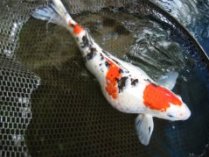 When you see this presentation, sometimes it is normal, and sometimes it is not. If the fish is a goldfish, and it's a male, you may notice that the body is SLIGHTLY peanut shaped, with a bulge on the right and a convex surface on the left. It's VERY subtle. If the assymmetry is noticeable to all, then it is NOT normal. If there is a bulge on one side of the fish, an ULTRASOUND should be done by a veterinarian trained in fish medicine to determine the content of the bulge, and then to determine if the bulge is a fea
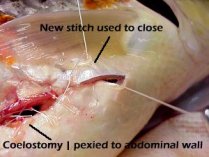 sible surgical target. What if the services of a veterinarian are not available? The fish which is affected by a bulge on one side, can sometimes be diagnosed by anesthetizing it in Oil of Cloves. A small knick incision can be made over the bulge, and the content of the bulge can then be observed directly. If pus is recovered, the bulge is probably caused by an abscess. A professional can open this lesion more and debride it. Closure of either the small diagnostic knick incision or the major open debridement is made via the modified figure-8 pattern
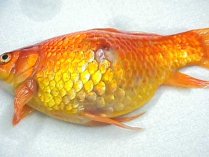 Belly is swollen all over and no scales seem to be raised.
Again, When you see this presentation, sometimes it is normal, and sometimes it is not. If the fish is a goldfish, and it's a male, you may notice that the body is SLIGHTLY peanut shaped, with a bulge on the right and a convex surface on the left. It's VERY subtle. If the assymmetry is noticeable to all, then it is NOT normal. If there is a bulge on one side of the fish, an ULTRASOUND should be done by a veterinarian trained in fish medicine to determine the content of the bulge, and then to determine if the bulge is a feasible surgical target.
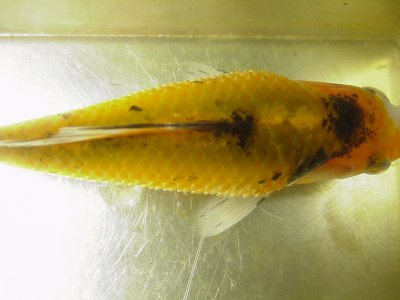 Belly is swollen all over and 100% of the scales are raised.
This presentation is Dropsy. Dropsy, also known as Bloater or Pinecone disease, is usually caused by bacterial invasion of the fishes' kidney.
There IS a sporozooan parasite that can damage the Kidney this way, called Mitraspora cyprini, but I have yet to see this on a necropsy.
Dropsy is, for all intents and purposes, untreatable, based on 7 years experience, using the following drugs: Azactam, Baytril, Chloramphenicol, Gentamicin, and Amikacin. I have tried a Sulfa drug, brand name Albon, and that did not resolve the problem either.
Bacterial dropsy is usually caused by Aeromonas or Pseudomonas bacteria. By the time the fish "blows up" and the scales protrude form the body, the damage to the kidney is so profound that recovery is impossible. If you must try to save the fish, Isolate the specimen, elevate temps while elevating oxygenation, and begin injecting antibiotics intraperitoneally. You could also feed the antibiotics in a medicated koi feed.
Action Items
+ Considering that any process which predisposes a single fish to bacterial infection ALSO predisposes its mates to the same fate, ALL fish should be treated to impeccable water quality, minimal crowding, excellent feeding practices, and then whatever antimicrobial you choose to use for the infection.